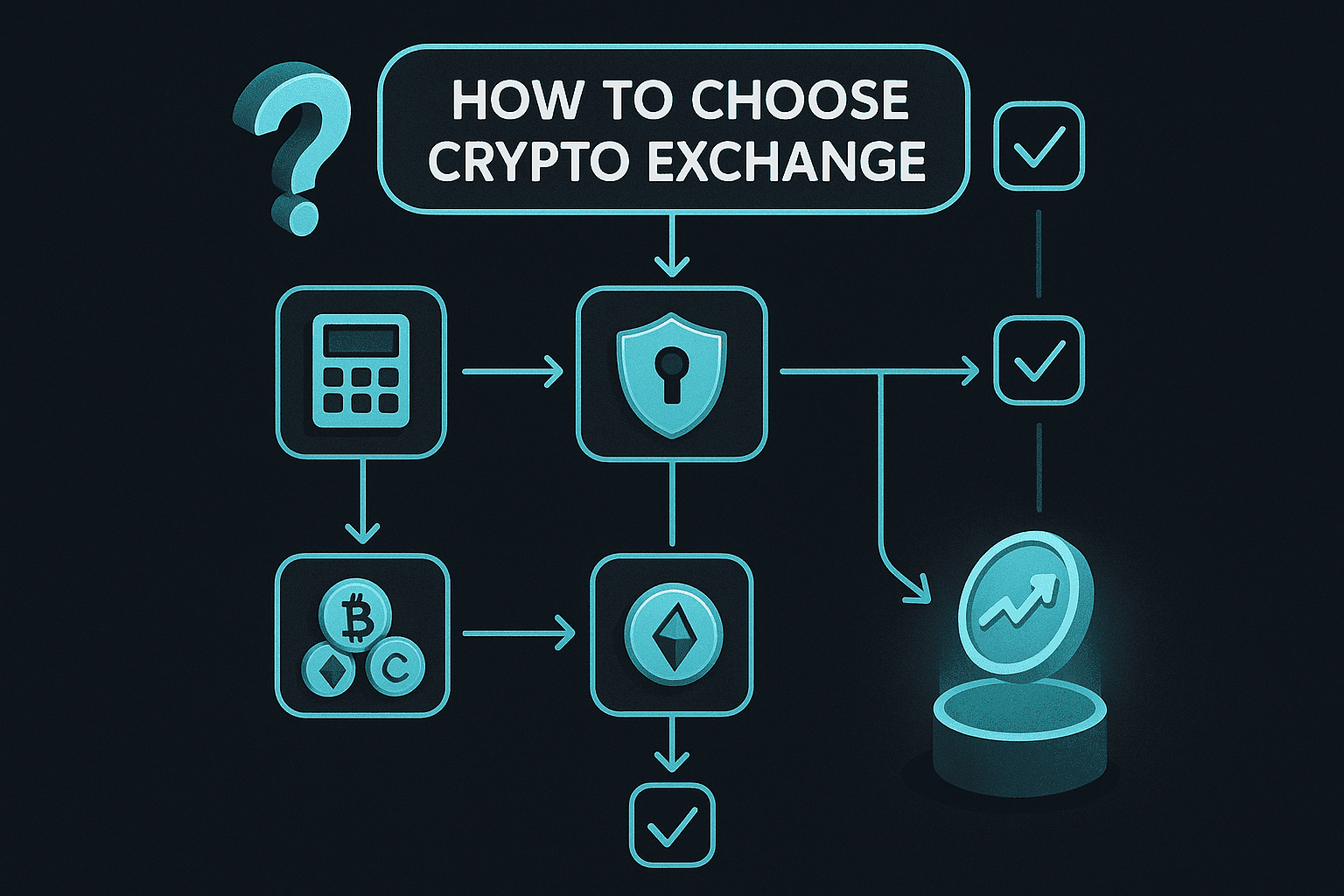
How to Choose a Crypto Exchange: Decision Framework
Choosing a crypto exchange is one of the most important decisions for any crypto trader or investor. The wrong choice can cost you in fees, expose you to security risks, or lock you out of features you need. This guide provides a systematic decision framework for selecting the right exchange based on your specific needs and trading style.
We'll cover the six critical factors you need to evaluate, provide a decision tree by user type, and highlight the red flags that should make you avoid an exchange entirely. For our complete ranking methodology, see ourmethodology page, and for specific exchange reviews, visit /exchanges.
The 6 Critical Factors for Exchange Selection
Not all factors are equally important for every user. A day trader cares more about liquidity and fees than a long-term holder, while a privacy-conscious user prioritizes KYC policies over institutional features. Here's how to evaluate each factor:
1. Security and Trust
Security is foundational. An exchange can have the best fees in the world, but if it gets hacked or becomes insolvent, you lose everything. Key security indicators include:
- Proof of Reserves (PoR): Does the exchange publish verified proof that it holds enough crypto to cover user balances? For details, see our PoR guide.
- Hack History: Has the exchange been compromised before? How did they handle it?
- Cold Storage: What percentage of funds are kept in cold (offline) storage?
- Insurance Coverage: Is there insurance protection for user funds?
- Two-Factor Authentication (2FA): Strong authentication requirements for accounts
- Withdrawal Whitelists: Can you restrict withdrawals to pre-approved addresses?
Learn more about evaluating exchange security in our comprehensivesecurity guide.
2. Fees and Cost Structure
Trading fees compound over time, especially for active traders. Understanding the fee structure is crucial:
- Maker/Taker Fees: Maker orders add liquidity (lower fees), taker orders remove liquidity (higher fees)
- Volume Discounts: Many exchanges offer lower fees for higher trading volumes
- Native Token Discounts: Some exchanges offer fee discounts when paying with their native token
- Withdrawal Fees: Fixed fees for moving crypto off the exchange
- Deposit Fees: Some exchanges charge for deposits (especially fiat)
- Hidden Costs: Wide bid-ask spreads can be more expensive than fees
For advanced fee optimization strategies, see our fee optimization guide.
3. Liquidity and Market Depth
Liquidity affects how easily you can buy or sell without moving the price. For large trades or volatile markets, this matters more than fees:
- Order Book Depth: How much volume is available at each price level?
- Bid-Ask Spreads: Tight spreads mean lower implicit trading costs
- 24h Volume: Higher volume generally means better liquidity
- Market Impact: How much does a typical trade size move the price?
- Slippage: Difference between expected and actual execution prices
4. Regulatory Compliance and Geographic Access
Regulatory status affects availability, features, and long-term viability:
- Geographic Restrictions: Is the exchange available in your country/state?
- Licensing Status: What regulatory approvals does the exchange have?
- KYC Requirements: What verification is required for different limits?
- Fiat Support: Can you deposit/withdraw in your local currency?
- Tax Reporting: Does the exchange provide tax documentation?
- Banking Relationships: Strong banking partners indicate regulatory standing
For more on KYC trade-offs, see our KYC vs No-KYC guide.
5. User Experience and Platform Features
A poor user experience can lead to costly mistakes or missed opportunities:
- Platform Stability: Does the exchange stay online during high volatility?
- Mobile App Quality: Is the mobile experience functional and reliable?
- Order Types: Limit, market, stop-loss, OCO, and advanced order types
- Charting Tools: Built-in technical analysis capabilities
- API Access: For algorithmic trading and portfolio management tools
- Customer Support: Response times and support quality
6. Supported Assets and Products
Different exchanges specialize in different assets and products:
- Coin Selection: Does the exchange list the assets you want to trade?
- Fiat Pairs: Can you trade directly against your local currency?
- Derivatives: Futures, perpetuals, options availability
- Margin Trading: Leverage options and requirements
- Staking/Earn: Passive income opportunities
- DeFi Integration: Connection to decentralized finance protocols
Decision Framework by User Type
Use this decision tree to narrow down your options based on your trading style and priorities:
For Beginners
Priority Order: Security โ User Experience โ Regulatory Compliance โ Fees
As a beginner, focus on safety and simplicity over advanced features:
- Choose exchanges with strong regulatory standing in your region
- Prioritize platforms with good educational resources and customer support
- Look for simple, intuitive interfaces over advanced trading tools
- Accept slightly higher fees in exchange for better security and support
- Start with major, established exchanges rather than newer platforms
Recommended starting points: For US users, consider Coinbase or Kraken. For EU users, Kraken or Bitstamp offer good beginner experiences with strong compliance.
For Day Traders
Priority Order: Liquidity โ Fees โ Platform Features โ Security
Day traders need tight spreads, fast execution, and advanced tools:
- Focus on exchanges with deep order books in your preferred pairs
- Look for maker/taker fee structures that reward liquidity provision
- Ensure the platform has advanced order types (stop-loss, OCO, trailing stops)
- Check platform uptime during volatile periods
- Consider API access for automated strategies
- Volume discounts can significantly reduce costs
Top choices: Binance, OKX, and Bybit offer excellent liquidity and trading tools. For US day traders, Kraken Pro provides the best combination of liquidity and features.
For Long-Term Holders (HODLers)
Priority Order: Security โ Regulatory Compliance โ Fees โ Staking Options
HODLers should prioritize security and passive income opportunities:
- Choose exchanges with strong proof of reserves and security track records
- Look for competitive staking yields and earn programs
- Consider withdrawal fees since you'll move funds less frequently
- Regulatory compliance is important for long-term peace of mind
- Check if the exchange offers custody services for large holdings
- Consider geographic diversification (holding on multiple exchanges)
For staking opportunities, see our staking guide.
For DeFi Users
Priority Order: Asset Selection โ Withdrawal Fees โ Security โ User Experience
DeFi users need access to a wide range of tokens and low withdrawal fees:
- Look for exchanges with extensive altcoin listings
- Check withdrawal fees for tokens you use frequently
- Consider exchanges that integrate with DeFi protocols
- Fast withdrawal processing is important for DeFi opportunities
- Some exchanges offer direct DeFi staking with better rates
- API access helps with portfolio management across platforms
Good options: KuCoin and Crypto.com offer broad asset selection, while OKX provides strong DeFi integration features.
For Privacy-Conscious Users
Priority Order: KYC Requirements โ Geographic Access โ Security โ Fees
If privacy is a priority, you'll need to make trade-offs on other features:
- Research KYC requirements and withdrawal limits without full verification
- Understand the legal risks in your jurisdiction
- Consider using multiple exchanges with smaller balances
- Look for exchanges that don't require KYC for basic trading
- Be prepared for limited features (no fiat, lower limits)
- Consider decentralized exchanges as alternatives
Learn more in our KYC vs No-KYC comparison.
For Institutional Users
Priority Order: Regulatory Compliance โ Liquidity โ Security โ Custody Services
Institutions have different needs than retail traders:
- Strong regulatory compliance and licensing is essential
- Look for institutional custody solutions and insurance
- Check for API rate limits and institutional endpoints
- Consider exchanges with dedicated institutional support
- OTC (over-the-counter) trading for large orders
- Reporting and compliance tools for audit requirements
Red Flags: When to Avoid an Exchange
Some warning signs should make you immediately look elsewhere, regardless of other factors:
Security Red Flags
- No Proof of Reserves: Exchanges that won't prove they hold user funds
- Recent Major Hacks: Especially if funds weren't fully restored
- Weak 2FA Implementation: SMS-only or optional two-factor authentication
- No Cold Storage: Keeping all funds in hot wallets
- Poor Security Practices: Storing passwords in plain text, weak encryption
Financial Red Flags
- Withdrawal Issues: Reports of delayed or frozen withdrawals
- Liquidity Problems: Unusually wide spreads or thin order books
- Hidden Fees: Undisclosed costs or suddenly changing fee structures
- Banking Problems: Lost banking relationships or frozen bank accounts
Operational Red Flags
- Frequent Downtime: Platform outages during volatile periods
- Poor Customer Service: No response to support tickets
- Regulatory Issues: Fines, sanctions, or license revocations
- Lack of Transparency: No information about team, location, or operations
- Fake Volume: Suspiciously high trading volumes compared to other metrics
Community Red Flags
- Negative Reviews: Consistent complaints about the same issues
- Social Media Issues: No official presence or constant user complaints
- Paid Reviews: Suspicious numbers of positive reviews appearing suddenly
- Scam Allegations: Community reports of fraudulent behavior
How to Research an Exchange Before Signing Up
Before creating an account, do your due diligence:
Background Research
- Check the exchange's regulatory status in your jurisdiction
- Research the founding team and company history
- Look up any past security incidents or regulatory issues
- Verify the company's legal registration and licenses
Community Feedback
- Read recent reviews on Reddit, Twitter, and crypto forums
- Check for complaints about withdrawals, customer service, or platform issues
- Look for feedback from users in your region
- Pay attention to how the exchange responds to complaints
Technical Analysis
- Test the platform with a small deposit first
- Check order book depth for your preferred trading pairs
- Test the withdrawal process with a small amount
- Evaluate the mobile app and web platform usability
- Check API documentation if you plan to use automated tools
Multi-Exchange Strategy
Consider using multiple exchanges rather than putting all your funds on one platform:
Benefits of Diversification
- Risk Reduction: No single point of failure
- Arbitrage Opportunities: Price differences between exchanges
- Feature Access: Different exchanges for different use cases
- Regulatory Hedging: If one exchange faces issues, others remain available
- Liquidity Access: Tap into different liquidity pools
Common Multi-Exchange Setups
- Main + Backup: Primary exchange for most trading, backup for emergencies
- Specialized Split: Different exchanges for spot, derivatives, and altcoins
- Geographic Split: Regulated exchange in your home country, offshore for additional features
- Security Split: Cold storage exchange for holdings, trading exchange for active funds
Making Your Decision
Once you've evaluated your options, create a simple scoring system:
Step 1: Weight Your Priorities
Assign weights to each factor based on your needs:
- Security: ___% (recommend 20-30% for all users)
- Fees: ___% (higher for active traders)
- Liquidity: ___% (critical for day traders)
- Regulation: ___% (important for beginners and institutions)
- UX/Features: ___% (varies by user type)
- Assets: ___% (important for DeFi users)
Step 2: Score Each Exchange
Rate each potential exchange on a 1-10 scale for each factor, then multiply by your weights.
Step 3: Consider Deal-Breakers
Eliminate any exchanges with red flags or that don't meet your minimum requirements (geographic access, specific assets, etc.).
Step 4: Test Before Committing
Start with a small deposit on your top choice. Test the features you need, try a withdrawal, and evaluate customer support if needed.
Final Recommendations
Remember that there's no "perfect" exchange for everyone. The best choice depends on your specific needs, risk tolerance, and geographic location. Here are some general guidelines:
- For most beginners: Start with a regulated exchange in your region (Coinbase, Kraken, or Bitstamp for most Western users)
- For active traders: Prioritize liquidity and fees (Binance, OKX, or Bybit if available in your region)
- For security-conscious users: Choose exchanges with strong PoR and security track records (Kraken, Binance)
- For altcoin traders: Look for broad asset selection (KuCoin, Crypto.com)
- For derivatives traders: Focus on platforms with deep derivatives liquidity (see our derivatives guide)
For our complete exchange rankings and detailed comparisons, visit /exchanges. The rankings are updated regularly based on our comprehensive scoring methodology.
Key Takeaways
- Security should be a top priority for all users, regardless of other needs
- Your trading style determines which factors matter most (liquidity for day traders, compliance for beginners)
- Red flags like withdrawal issues or poor security practices should be immediate disqualifiers
- Consider using multiple exchanges to diversify risk and access different features
- Always test an exchange with small amounts before committing significant funds
- Regulatory landscape changes frequently, so keep monitoring your chosen exchanges
Ready to compare specific exchanges? Check out our detailed reviews and live rankings on/exchanges, or dive deeper into specific topics with our other academy guides.

