
Binance Is Losing Market Share in 2026: What It Means for Traders
The crypto exchange landscape has undergone seismic shifts since October 2025, with Binance experiencing unprecedented market share erosion. From Bitcoin spot trading dominance to derivatives leadership, the world's largest crypto exchange is facing headwinds that are reshaping how traders choose their platforms. For comprehensive exchange comparisons, see our platform rankings.
The Numbers Don't Lie
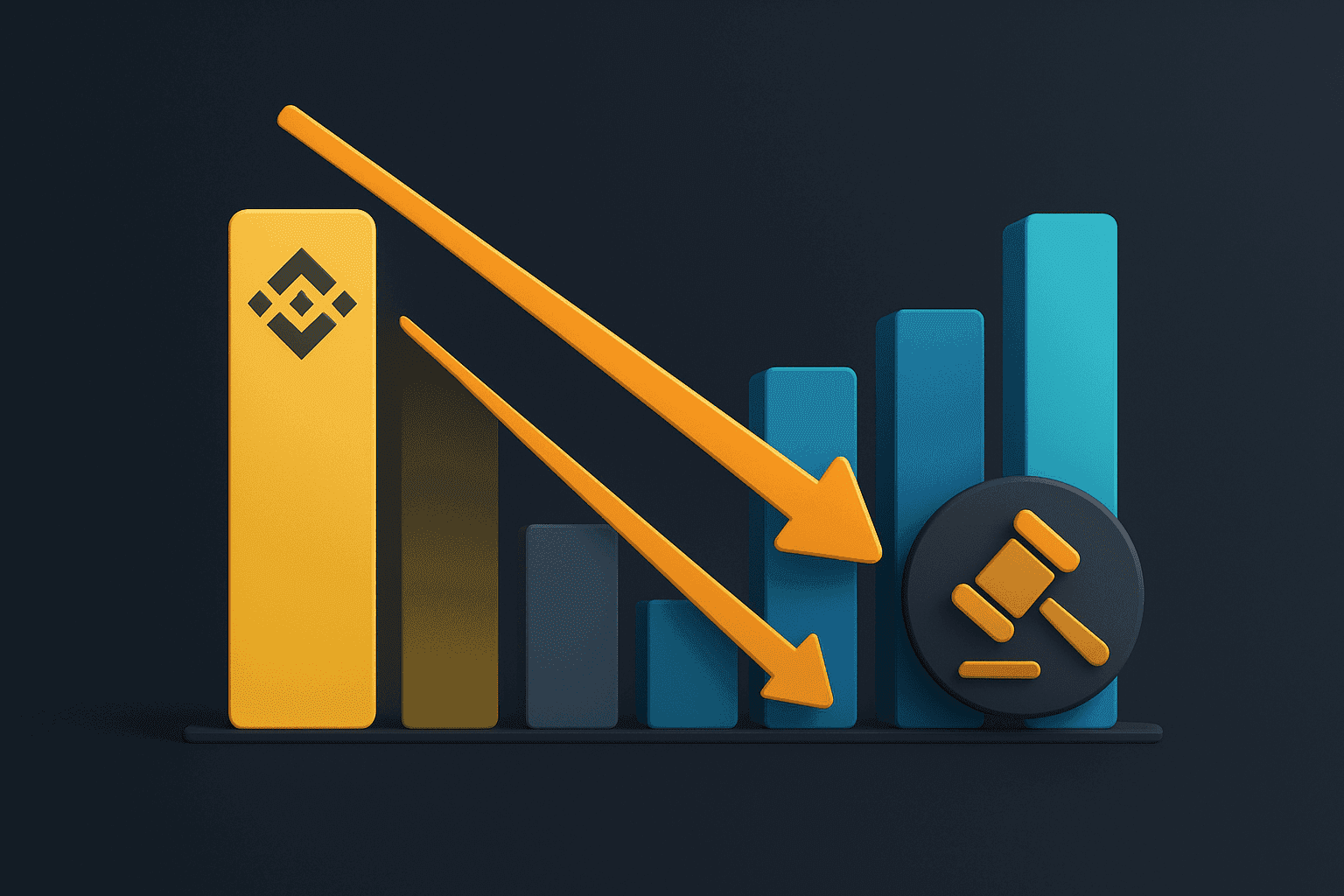
Binance's market dominance has cracked across all major segments. In Bitcoin spot trading, their share has plummeted from 77% to just 27% in less than six months. Overall spot trading volume has fallen from 52% to 32%, while derivatives trading—historically Binance's stronghold—has dropped from 76% to 34%.
These aren't minor adjustments. We're witnessing the most significant exchange market redistribution since Mt. Gox collapsed in 2014. The question isn't whether Binance will recover—it's whether this marks a permanent shift toward exchange diversification.
Where the Volume Went
Institutional traders have largely migrated to regulated exchanges like Coinbase and Kraken. Retail traders are spreading across Bybit, OKX, and regional players. The "Binance or nothing" era appears to be ending.
October 2025: The Catalyst Event
The October 2025 market crash wasn't just about falling prices—it exposed fundamental trust issues. When Bitcoin dropped 40% in three days, Binance processed $19 billion in liquidations, creating a liquidity crisis that temporarily froze withdrawals for retail accounts.
What Went Wrong
- Liquidity Crunch: Market makers pulled back simultaneously, creating a cascade effect
- System Overload: Trading engines couldn't handle peak liquidation volume
- Communication Breakdown: Users received conflicting information about withdrawal restrictions
- Insurance Fund Questions: SAFU fund coverage appeared insufficient for the scale of losses
While other exchanges faced similar pressures, Binance's size made its problems more visible. Traders who lost access to funds during the crisis began questioning whether concentration risk was worth the convenience.
The Institutional Migration
Institutional adoption has been crypto's biggest growth driver, but institutions demand regulatory clarity and operational transparency. Binance's regulatory challenges in the US, Europe, and Asia have pushed institutional volume toward compliant alternatives.
Coinbase's Institutional Gains
Coinbase Prime and Advanced Trade have captured significant institutional flow, particularly from US-based funds and family offices. Their FDIC insurance for USD deposits and regulatory compliance have become competitive advantages.
Kraken's European Push
Kraken has aggressively expanded in Europe, offering regulated custody services and derivatives trading through Kraken Pro. Their focus on compliance has attracted European institutional clients shifting away from Binance.
New Market Maker Transparency Rules
Regulatory pressure has forced exchanges to disclose market maker relationships and provide real-time liquidity data. These transparency requirements favor exchanges with diverse market maker networks over those dependent on proprietary trading.
Impact on Trading Quality
Improved transparency has revealed that Binance's tight spreads sometimes came at the cost of depth. When market conditions deteriorated, this shallow liquidity evaporated quickly. Exchanges with more diverse market maker relationships maintained better execution quality during stress periods.
What This Means for Traders
- Better Price Discovery: Multiple exchanges now offer competitive execution
- Reduced Concentration Risk: Spreading trades across platforms reduces operational risk
- Improved Transparency: Real liquidity data helps traders make better platform choices
- Enhanced Competition: Lower market concentration drives innovation and fee competition
How CryptoScorer Reflects These Changes
Our scoring methodology has captured Binance's decline through several key metrics:
Security & Reserves (30% Weight)
Binance's security score dropped following October's liquidity crisis. Questions about SAFU fund adequacy and withdrawal restrictions during peak stress reduced their security rating from A+ to B+.
Regulation (12% Weight)
Ongoing regulatory challenges in major jurisdictions have kept Binance's regulatory score low. Meanwhile, competitors like Coinbase and Kraken have improved their compliance ratings.
Liquidity (15% Weight)
While Binance still offers deep liquidity in major pairs, the quality degradation during stress periods has impacted their liquidity scores. Exchanges that maintained consistent execution during October's crisis scored higher.
Health (7% Weight)
Platform stability issues during the crisis reduced Binance's health scores, while competitors that maintained normal operations saw relative improvements.
What This Means for Your Trading Strategy
The exchange landscape is becoming more competitive and diverse. Here's how to adapt:
Diversify Your Exchange Risk
Don't put all funds on one exchange, regardless of size. October 2025 proved that even the largest platforms can face operational challenges. Consider spreading funds across 2-3 top-rated exchanges.
Prioritize Regulatory Clarity
If you're in a jurisdiction with clear crypto regulations, favor exchanges with proper licensing. This reduces the risk of sudden service terminations or asset freezes.
Monitor Liquidity Quality
Don't just look at trading volume—examine order book depth and execution quality. Our exchange comparison tool helps you evaluate liquidity across platforms for your specific trading pairs.
Understand Insurance Coverage
Review what's actually covered by exchange insurance funds. FDIC insurance (Coinbase USD) is different from exchange insurance funds (Binance SAFU), which are different from custody insurance (institutional offerings).
Looking Forward: A More Balanced Market
Binance's market share decline likely represents a healthy maturing of the crypto exchange ecosystem. Instead of one dominant player, we're seeing competitive pressure drive innovation in security, compliance, and user experience.
Winners in the New Landscape
- Regulated Exchanges: Coinbase, Kraken, Gemini benefit from institutional trust
- Regional Leaders: Bitflyer (Japan), Coinsquare (Canada), Independent Reserve (Australia)
- Derivatives Specialists: Bybit and OKX are capturing derivatives volume with better risk management
- DeFi Bridges: Exchanges that integrate well with DeFi protocols attract yield-seeking traders
What to Watch
Monitor regulatory developments, particularly US stablecoin legislation and EU MiCA implementation. These changes will continue reshaping exchange market share throughout 2026.
Choose Your Exchange Wisely
The crypto exchange oligopoly is breaking down, giving traders more choice than ever. Use tools like our exchange rankings and security guides to make informed platform decisions.
In a world where no single exchange dominates, diversification isn't just smart—it's essential. The exchanges that succeed in this new environment will be those that prioritize transparency, regulatory compliance, and genuine user protection over pure market share.
Frequently Asked Questions
Why is Binance losing market share in 2026?
Binance faces multiple challenges including regulatory pressure, increased competition, user concerns about centralization, and the rise of specialized platforms. Their spot market share dropped from 77% to 27% for Bitcoin trading as traders diversify to multiple exchanges.
Is Binance still safe to use despite market share loss?
Binance remains one of the most secure and liquid exchanges available. Market share loss doesn't necessarily indicate safety issues - it often reflects increased competition and user preference for diversification rather than platform problems.
Which exchanges are benefiting from Binance's market share decline?
OKX, Bybit, Coinbase, and regional players are gaining share. OKX particularly benefits from Binance's derivatives volume loss, while Coinbase captures regulatory-focused users. Smaller exchanges are also seeing growth as traders diversify.
Should I move my crypto from Binance to other exchanges?
Rather than completely abandoning Binance, consider diversifying across multiple exchanges. This reduces counterparty risk while allowing you to access different features, fees, and liquidity pools. Never keep all funds on a single platform.